
1 · IDENTIFY
Read the information in an element cell
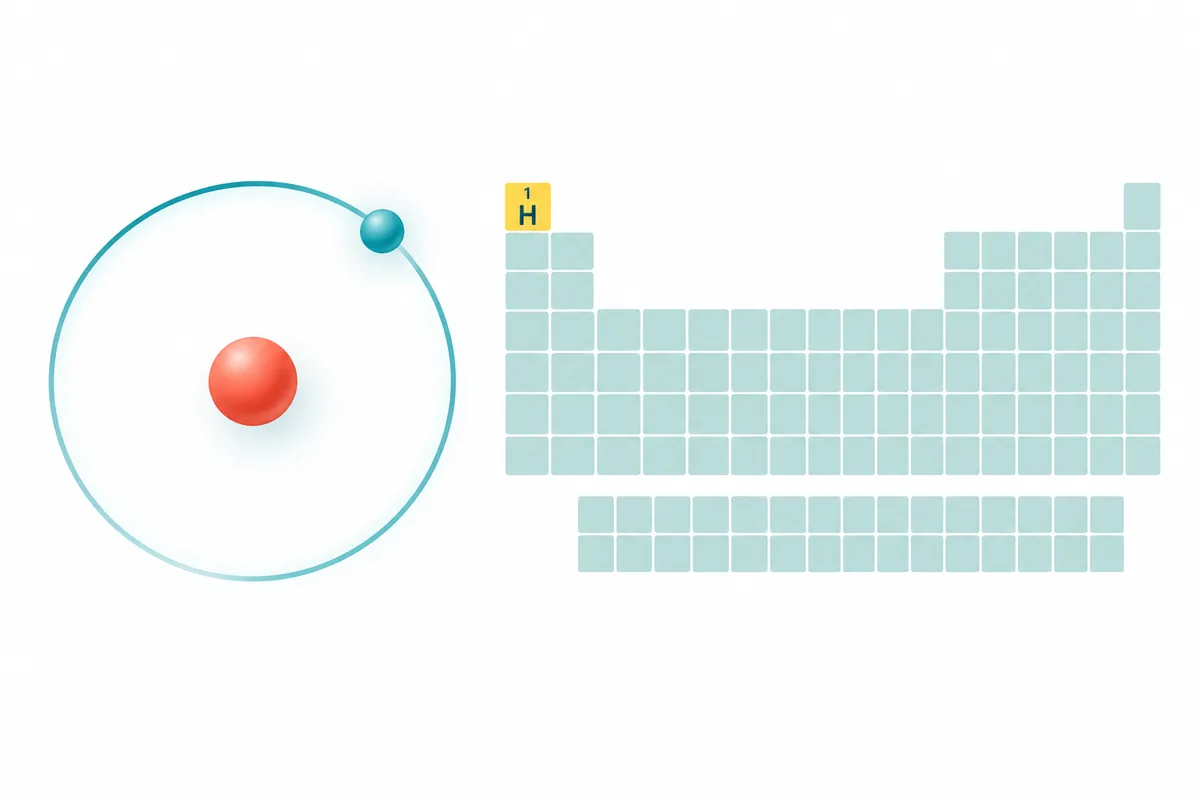
Layouts vary slightly, but an element cell often shows the atomic number, chemical symbol, name and a relative atomic mass value. These details are not interchangeable. The number and symbol identify an element; the mass describes a property connected with its isotopes. If a cell shows other data, such as electronegativity, check the legend and unit.
The atomic number, written Z, is the number of protons in the nucleus. It is the same for every atom of a given element. A neutral atom has the same number of electrons as protons; an ion does not, because it has gained or lost electrons. A symbol starts with a capital letter and may have a second lowercase letter: Co is cobalt, while CO is the formula for carbon monoxide.
Relative atomic mass is not the neutron count of one particular atom. It reflects the isotopes of an element. For an isotope exercise, use its notation or the supplied information that distinguishes protons from neutrons.
- Atomic number: the element's identity and number of protons.
- Symbol and name: chemical notation where capitalization matters.
- Relative atomic mass: an isotope-related average, not an element number.
2 · LOCATE
The period: read the horizontal row
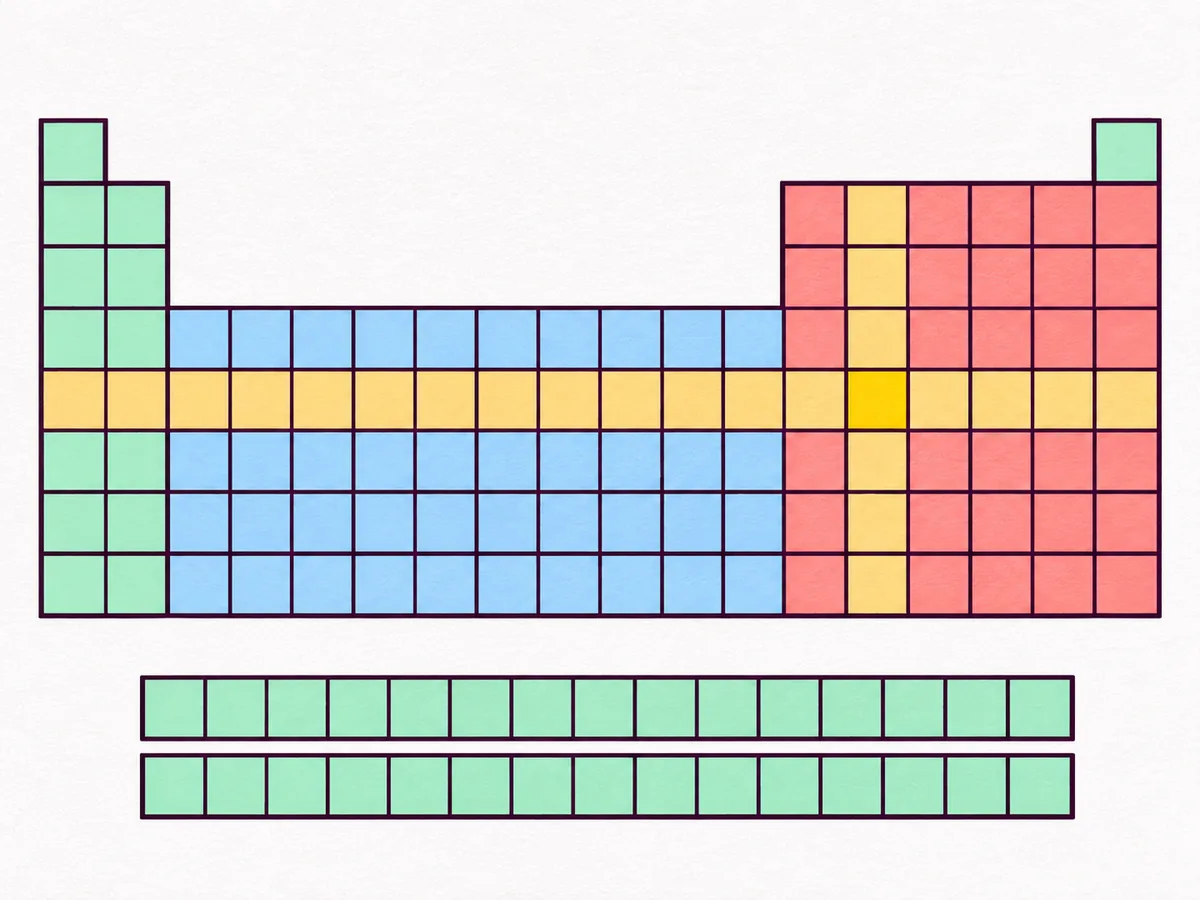
A period is a horizontal row. The standard table has seven periods, numbered 1 through 7. Moving along a row, the atomic number increases from one cell to the next. Sodium (Na, Z = 11), magnesium (Mg, Z = 12) and chlorine (Cl, Z = 17), for example, all belong to period 3 even though their properties differ.
In a school-level description of main-group elements, the period helps locate the outer occupied level. It does not give the number of valence electrons. The d and f blocks need a more careful reading; the two rows at the bottom belong to periods 6 and 7. To see how to read the periodic table in context, keep the row separate from the electron count.
3 · COMPARE
The group: read the column and family
A group is a vertical column. International numbering runs from 1 to 18. In the main groups, elements in one column often have related chemical behavior because their outer-electron structures are similar. That is why columns also have family names, such as alkali metals in group 1 and halogens in group 17.
A group helps you compare elements, but it does not guarantee identical reactions. Transition metals may have several oxidation states; helium and hydrogen are also special cases in their columns. Hydrogen is often drawn above group 1, but it is a nonmetal.
For some main-group elements, the column can suggest a common ion. Magnesium often forms Mg²⁺ in ionic compounds. Always check the other substances and conditions before drawing a conclusion about a reaction.
4 · ORGANIZE
Families and blocks: why the table is divided
Alkali metals occupy group 1 except for hydrogen; alkaline-earth metals are in group 2, halogens in group 17 and noble gases in group 18. Transition metals span several columns. The boundary of some families can depend on the convention used by a textbook.
The s, p, d and f blocks name the subshell being filled. They help explain the grid's shape and how to read an electron configuration. When you are starting out, compare a family and the properties actually provided instead of relying on color alone.
5 · APPLY
Worked example: read magnesium and chlorine
Take magnesium. Its atomic number is 12, so its nucleus contains 12 protons and a neutral atom has 12 electrons. Its symbol is Mg, and it sits in period 3, group 2. It therefore belongs to the alkaline-earth metals. In an introductory course, you can connect its position with a common tendency to form Mg²⁺ in ionic compounds.
Chlorine has Z = 17 and the symbol Cl. It is also in period 3, but in group 17, the halogens. A neutral chlorine atom has 17 electrons; in many salts, a chloride ion, Cl⁻, has one more. Comparing Mg with Cl shows why reading the row and column together is more useful than memorizing an isolated color.
Hydrogen is often shown above group 1, but its properties differ from those of lithium and sodium. Its position gives context; a reaction also depends on the substances and conditions.
Before solving a worksheet question, identify exactly what it asks for and select the matching fact from the cell. Z gives the proton count. For a named isotope, subtract Z from the mass number to find neutrons. If no isotope is specified, relative atomic mass cannot determine the neutron count of one particular atom.
To compare two elements, compare the same property and state the expected direction from their positions. If the exercise supplies a value, keep it distinct from a broad trend. Separating a positional clue from a measured or tabulated number makes the reasoning behind your conclusion clearer.
| Element | Atomic number | Group / period | First interpretation |
|---|---|---|---|
| Sodium (Na) | 11 | 1 / 3 | Alkali metal; it commonly forms Na⁺ in salts. |
| Magnesium (Mg) | 12 | 2 / 3 | Alkaline-earth metal; Mg²⁺ is common in ionic compounds. |
| Chlorine (Cl) | 17 | 17 / 3 | Halogen; Cl⁻ occurs in many salts. |
6 · INTERPRET
Read periodic trends without treating them as absolute
Atomic radius tends to increase down a family and toward the left of the table. Electronegativity and first ionization energy generally tend to increase toward the top and right. These directions help compare elements in one area, but the definition of a property, electron structure and exceptions also matter.
Name the property first: atomic size and attraction for a bonding pair are different questions. State the expected direction, compare the positions and check that the trend applies. For a precise value, use a source that gives its unit and context.
A REUSABLE METHOD
How to read the periodic table in an exercise: five steps
- 1. Identify
Record Z, the symbol and the name.
- 2. Locate
Find the period first, then the group.
- 3. Classify
Name the family or block shown.
- 4. Connect
Link the position to the property in question.
- 5. Qualify
Check the data and the exercise conditions.
QUICK SELF-CHECK
How to read the periodic table with sulfur
Sulfur has the symbol S and atomic number 16. From its position, identify its period, group and family. What can you conclude without knowing a particular reaction?
Show an explained answer
Sulfur is in period 3, group 16, in the chalcogen family. Z = 16 means 16 protons and, for a neutral atom, 16 electrons. The family helps compare its properties, but does not determine a specific reaction by itself.
FREQUENT QUESTIONS
How to read the periodic table: common questions
What does the atomic number in a cell mean?
It gives the number of protons in the nucleus and identifies the element. A neutral atom has the same number of electrons, unlike an ion.
What is the difference between a group and a period?
A group is a vertical column numbered 1 to 18. A period is a horizontal row numbered 1 to 7.
Does the period number always give the number of valence electrons?
No. For main-group elements it helps locate the outer level in a simplified description, but it does not directly give the number of valence electrons. The d and f blocks need more context.
Why are elements in one group similar?
In the main groups, patterns in their outer electrons contribute to related properties. Transition metals and exceptions make the comparison more nuanced.
Is atomic mass the number of neutrons?
No. A cell's relative mass generally accounts for isotopes and is not the neutron count of one particular atom. The neutron count depends on the isotope.
Can the periodic table predict every reaction?
No. Position suggests trends and common behavior. A reaction also depends on the reactants, bonds and conditions, so examine the equation and context.
Sources and references
- IUPAC: Periodic Table of ElementsInstitutional reference for the table and element names.
- CEA: The Mendeleev table infographicLearning resource showing element cells, electron shells and the table's overall organization.