
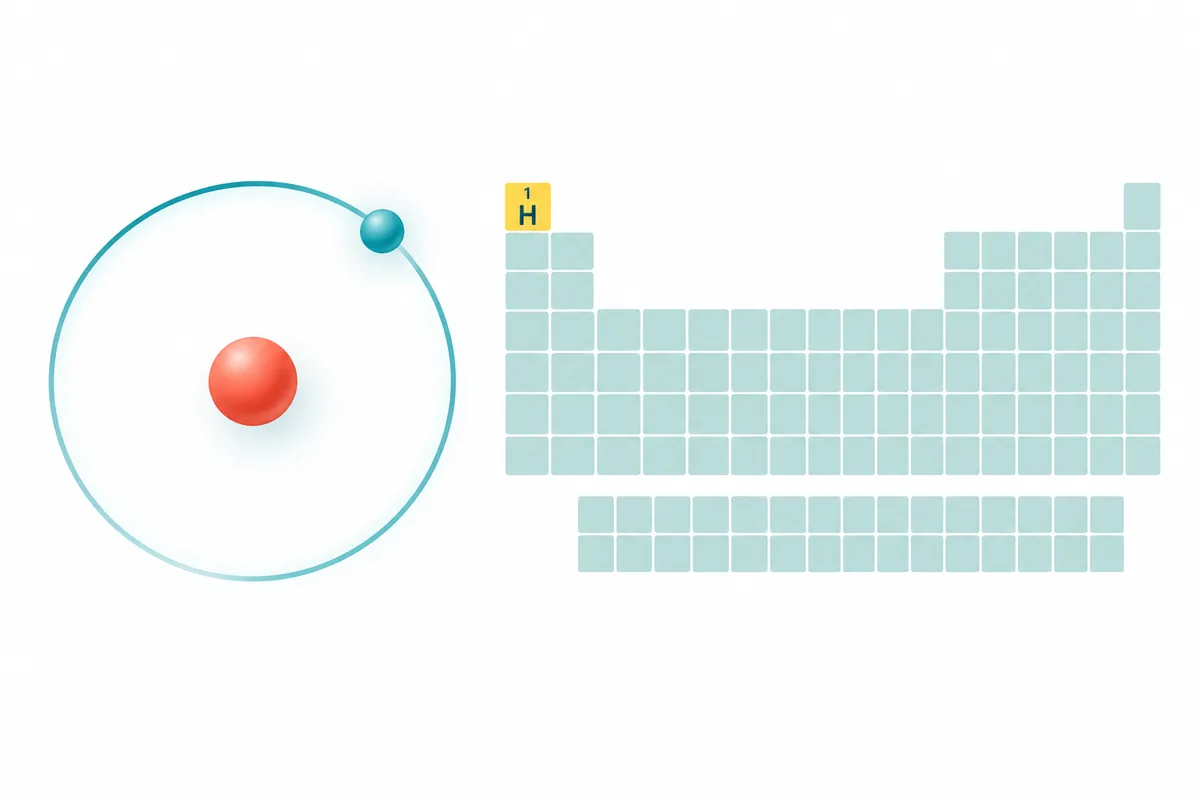
POSITION
Where is hydrogen on the periodic table?
Hydrogen sits at the top of period 1, at the far left of the periodic table. It comes before helium, which ends that first row. A period is a row: for hydrogen, period 1 indicates that its electron occupies the first energy level. Hydrogen and helium are the only elements in this row, but they should not be grouped together just because the row is short.
Most tables place hydrogen in the group 1 column. That layout makes its single outer electron easy to see and helps explain its electron configuration. The similarity with the typical group 1 metals quickly stops, however. Lithium and sodium are solid metals that readily lose an electron, while hydrogen is a nonmetal that normally exists as H₂ molecules. Some tables therefore separate the hydrogen cell or add a note about its unusual classification.
ATOM AND ELECTRONS
Atomic number, nucleus and electron configuration
Atomic number 1 means that every hydrogen nucleus contains one proton. The most common form, called protium or hydrogen-1, has no neutron in its nucleus. A neutral atom adds one electron around that nucleus. This simple structure makes hydrogen a useful starting point when learning what the numbers and symbols in a periodic-table cell represent.
The electron configuration is written 1s¹: 1 names the first energy level, s names the subshell type, and the superscript 1 shows that it contains one electron. This helps explain why hydrogen is often aligned with group 1, but it does not mean a neutral atom is already an ion. H can refer to a hydrogen atom, H₂ to a molecule of two bonded atoms, H⁺ to an ion that has lost its electron, and H⁻ to an ion that has gained one.
MASS AND PHYSICAL STATE
Hydrogen atomic mass and physical properties
The standard relative atomic mass of hydrogen is listed here as 1.008 u. It is not exactly 1 because a normal sample can contain isotopes with different masses. A periodic-table cell gives a reference average, whereas the mass number of a particular isotope counts its protons and neutrons. Atomic number remains the decisive identifier for the element.
At 20 °C and ambient pressure, elemental hydrogen is a colourless, odourless gas. It normally occurs as diatomic H₂ molecules rather than isolated H atoms. At a pressure of one atmosphere, its melting point is about 13.99 K and its boiling point is about 20.271 K. These low temperatures describe changes between solid, liquid and gas under stated conditions; they are not everyday operating temperatures.
NUCLEAR VARIANTS
Why does hydrogen have several isotopes?
Isotopes are atoms of the same element with the same number of protons but different numbers of neutrons. They keep the same atomic number and remain hydrogen even though their mass numbers differ. This distinction explains why the table's average atomic mass is not a whole number and why a detailed element guide separates an element symbol from isotope notation.
The three names to know are protium, deuterium and tritium. Protium is the lightest and most common form; deuterium has one additional neutron; tritium has two and is radioactive. The first two isotopes are stable, while tritium decays over time. Their different nuclei can affect mass and some reaction rates, but none changes hydrogen's atomic number of 1.
IN SPACE AND ON EARTH
Natural abundance and chemical role
Hydrogen is the most abundant element in the universe and is found in the Sun and many other stars. On Earth it is encountered mainly combined with other elements, rather than in large stores of pure gas. Water contains two hydrogen atoms per molecule, and hydrogen is also bonded to carbon, oxygen, nitrogen and other elements in many molecules found in living things.
Molecular hydrogen makes up only a very small fraction of Earth's atmosphere, less than one part per million by volume according to the Royal Society of Chemistry. Hydrogen is therefore abundant on a cosmic scale but rarely present by itself in everyday surroundings. In chemistry, its role depends on the compound and reaction; a property of a molecule containing H should not automatically be assigned to isolated hydrogen.
HISTORICAL NOTES
From Cavendish's experiments to Lavoisier's name
Flammable gas from reactions between metals and acids had been observed before the eighteenth century, but Henry Cavendish studied it systematically. In 1766 he collected gas released by certain reactions and showed that it behaved as a distinct substance. His later combustion experiments helped establish that water could be formed from hydrogen and oxygen, rather than being a simple element itself.
Antoine Lavoisier later proposed the name hydrogen, built from Greek roots associated with water and production. The name recalls a historical result, but the modern periodic-table cell identifies the element by atomic number, not by its history. To locate H today, read its number 1, symbol and period; the discovery story explains how chemists learned to distinguish the gas.
USES AND TERMINOLOGY
Hydrogen uses and the difference from hydrogen energy
Molecular hydrogen is used in several industrial processes. It is used to make ammonia through the Haber-Bosch process, remove sulfur from some fuels, and alter oils through hydrogenation. Fuel cells can also convert the chemical energy of hydrogen into electricity. In each case, the reaction and operating conditions matter: the element's name alone does not describe a process or its environmental impact.
A guide to the element hydrogen answers questions such as “What is its symbol?”, “Where is H?” and “How many protons does it have?” A guide to hydrogen energy instead concerns production, storage, transport and the footprint of an energy system. Water, hydrogen peroxide and hydrocarbons are also distinct compounds that contain hydrogen; they are not interchangeable forms of pure hydrogen. Keeping these topics separate makes the periodic-table facts easier to use.
THREE ISOTOPES TO DISTINGUISH
Protium, deuterium and tritium
The symbol H stays the same, but isotope notation specifies the total number of nucleons. The superscript is the mass number.
Protium ¹H
One proton and no neutron in the nucleus. It is the most abundant naturally occurring form of hydrogen and is stable.
Deuterium ²H or D
One proton and one neutron. This isotope is stable; water containing deuterium is often called heavy water.
Tritium ³H or T
One proton and two neutrons. It is radioactive and occurs naturally in much smaller amounts than the other two forms.
FREQUENTLY ASKED QUESTIONS
Questions about hydrogen and its cell
What is the atomic number of hydrogen?
Hydrogen's atomic number is 1. Every hydrogen nucleus contains one proton, and a neutral atom also has one electron.
Where is hydrogen in the periodic table?
It is in period 1 at the upper left. It is often placed above group 1, although some tables set it apart to show that it is a nonmetal with distinctive properties.
Is hydrogen an alkali metal?
No. Hydrogen has one outer electron, but it is a gaseous nonmetal and does not have the physical and chemical properties of alkali metals.
Why is hydrogen's relative atomic mass close to 1.008 u?
The reference value reflects the isotopic composition of a natural sample. Hydrogen isotopes all have one proton but differ in neutron count and mass.
What is the difference between H and H₂?
H is the element symbol and can refer to one hydrogen atom. H₂ is a molecule made of two bonded hydrogen atoms, the usual form of elemental hydrogen gas.
What are the isotopes of hydrogen?
The three main names are protium (¹H), deuterium (²H or D) and tritium (³H or T). They all have atomic number 1 and differ in neutron count.
Sources consulted
- Royal Society of Chemistry — HydrogenReference data for relative mass, phase-change temperatures, isotopes, abundance, history and uses.
- French Alternative Energies and Atomic Energy Commission — Mendeleev's tableEducational reference for atoms and the periodic classification.